Erótica Laboral [Workplace Erotica]
July 2022
Enlace Art in progress. Serra de Daró, Girona, Spain
Curated by Leandro Martínez Depietri
From Netflix series to decorative pillows, the injunction to follow one's dreams and never give up on them is disseminated with unusual force and ends up engraved in people’s flesh through tattoos of catchphrases purporting to be wise. However, the emphasis on productivity and the orientation of all vital activity towards the maximization of economic profit as the ultimate goal in life leads to a society that, quite on the contrary, is disconnected from desire and in which only entrepreneurial dreams have room for development. Such a scheme of relations finds its correlate in the art world in the bureaucratization of the young artist who is forced to constantly fill out applications for awards, residencies and so on, and in the confinement of the established artist to an overwhelming studio production that is able to feed the insatiable beast of the global exhibition machine. As the demand on artists grows, the corporate model of the studio with assistants, producers and managers takes hold.
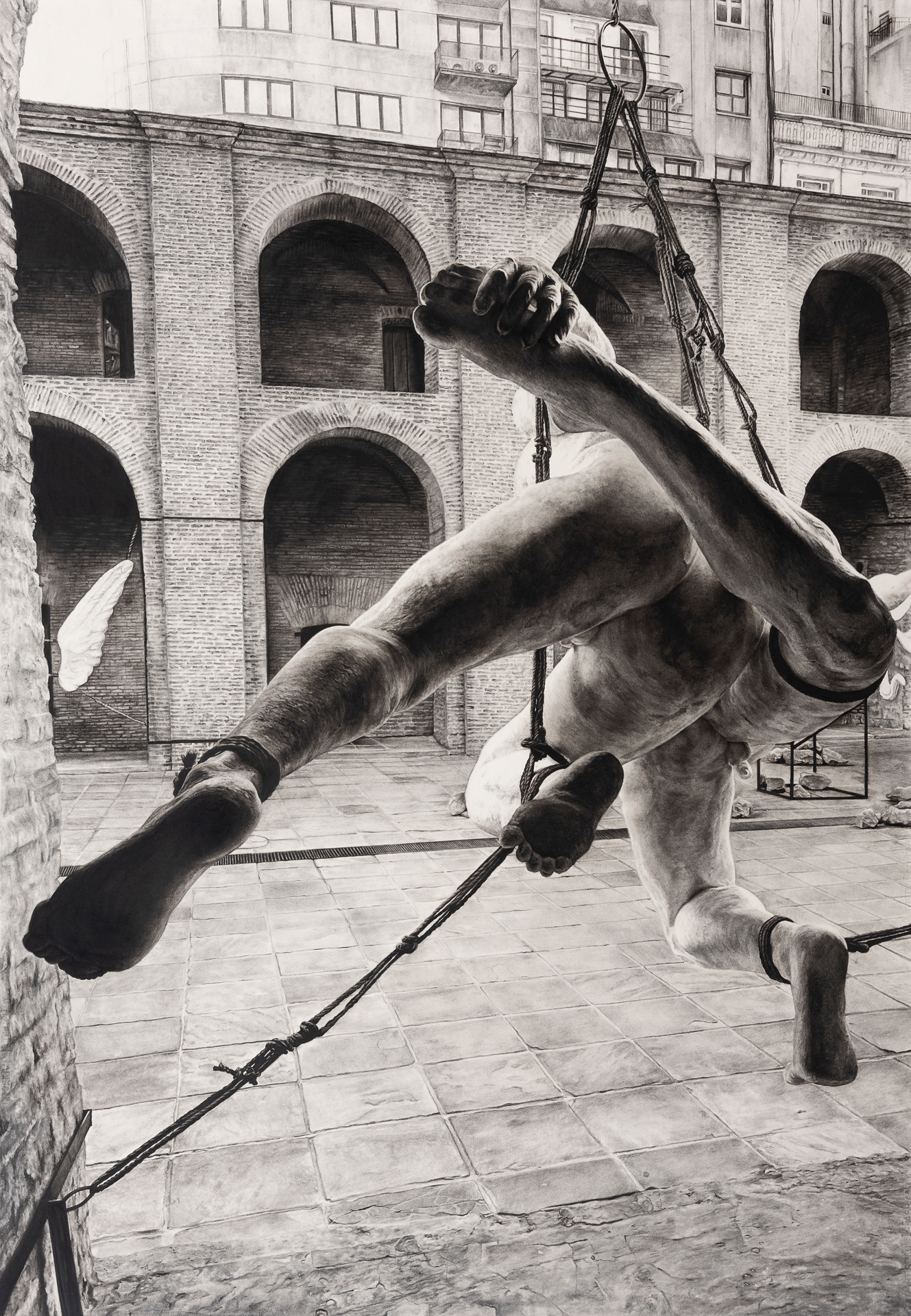
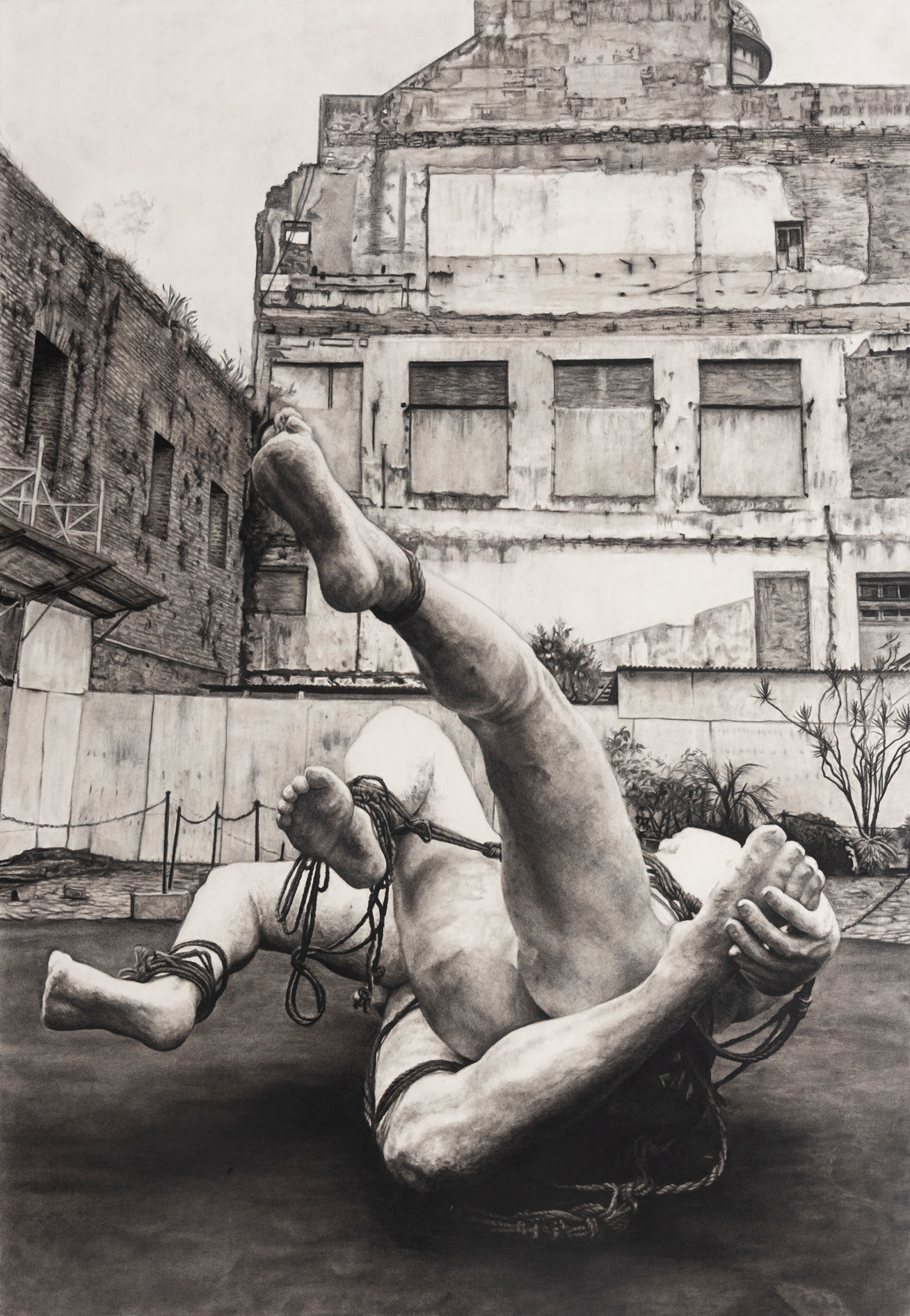
Alexis Minkiewicz is a young but rising artist on the Argentinean scene, with an increasingly evident international projection thanks to his participations in the Santa Cruz de la Sierra Biennial (2016), the Nomad Biennial at the Museum of Contemporary Art in Santiago de Chile (2018), the Curitiba Biennial (2019) and Bienalsur (2021). As his professional development continues, Alexis finds himself more and more confined to studio work and to managerial affairs. It is in this particular context that a profound reflection on his present life dynamic filtered into his own artwork. The impulse began with the desire to mount an exhibition that would bring the sculptor's workshop into the museum in order to open up the workplace to society at large. Although this project did not materialize, this thought process later gave shape to a series of drawings about situations that are adjacent to the exhibition practice. A first image was born from a photograph that Alexis took during the dismantling of a show while waiting for the lorry that was going to take his sculptures from Bienalsur to a warehouse. The picture shows the intertwined legs of the two sailors who form part of his distorted version of the monument to Columbus. Stripped of the monumental magnificence that they exhibited during the show, the perspective of the drawing highlights the friction of these resting bodies and gives them a desiring humanity. These intimate situations, which reflect work dynamics in their most anodyne instances, become somewhat truer than the sculpture itself insomuch as they also document the life of the artist-manager without pretense.
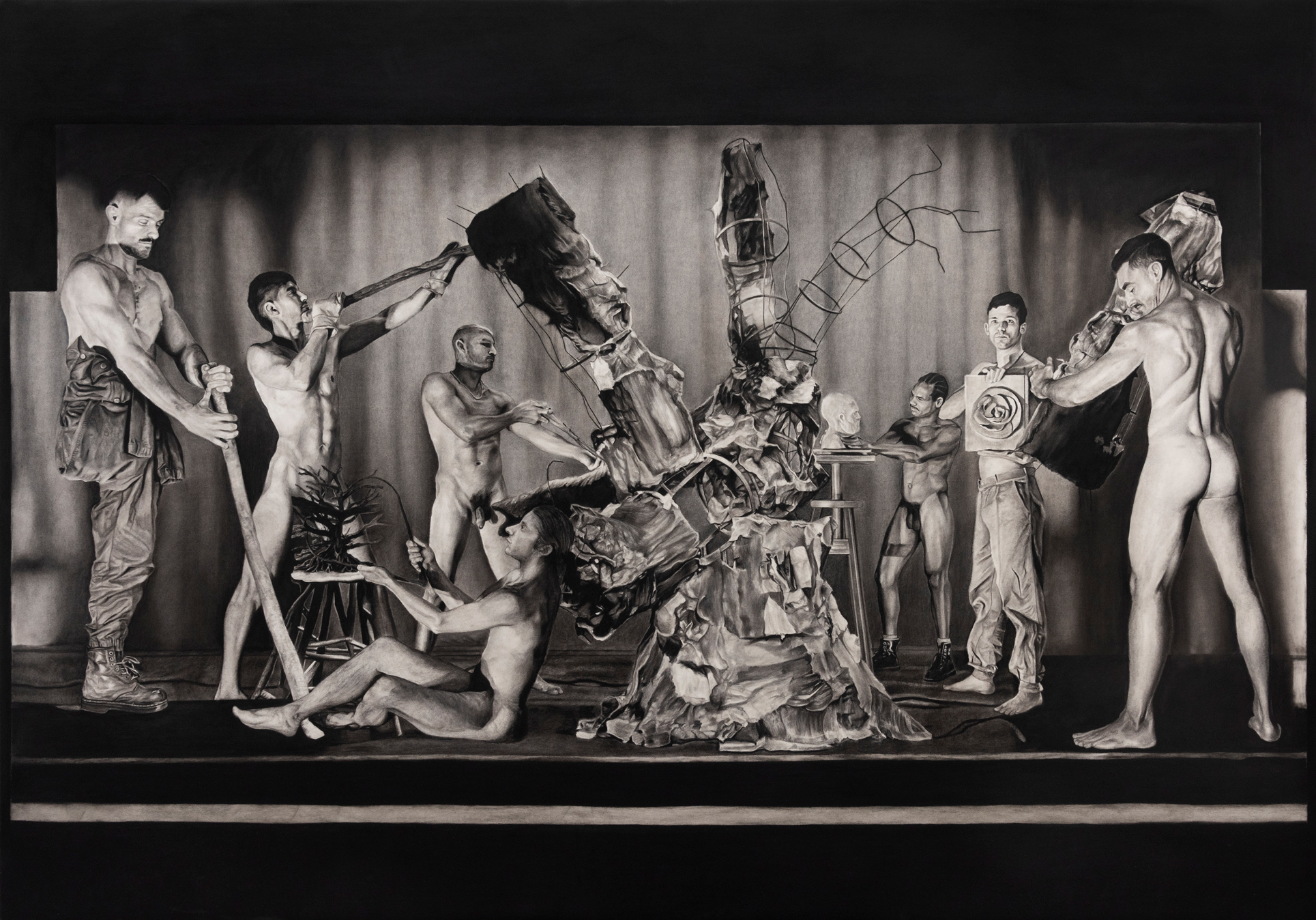
Exploration in the field of work triggered in Alexis the memory of a primary image, of those constitutive scenes of childhood in which a moment of self-discovery crystallizes. Alexis spent his youth between Lanús and Avellaneda - in the urban and industrial periphery of Buenos Aires - a few blocks away from a famous glass factory whose front bore a relief by Jockl that glorified the laborer’s work. His queer child's gaze is struck by this mural in which idealised male figures coexist in an enclosed environment, with their muscles gathered in the service of a common task. The projection of his homoerotic desire on this relief gives rise in the present to a project of restaging this factory scene, which Alexis turns into a territory for erotic play within the framework of a sculpture workshop. This is the origin of the mural, the centerpiece of this exhibition at Enlace Art in Progress. His fetishes come together in this image. Trees -a recurring motif in his work- are now the subject of a sculptural assemblage that is being made by a series of nude, or barely covered. male figures. Its branches become phallic symbols that interact with the workers. One of them penetrates a relief of an anus that is held by one of the assistants; another is inserted into the mouth of a worker, who seems to operate on it as if it were blown glass. In the foreground, a seated and naked assistant, wearing a dog's tail, measures with a sculpture's compass the miniature sculpture of a tree that covers the blower's groin. Next to him, another worker seems to be kneading a branch with two hands, which might later be assembled by the naked figure on the right who seems to be holding, or hugging, the tree. Finally, under the shade of the branches, a last worker wearing virtual reality glasses, models an object in the shape of an anal dildo. The ensemble depicts an orgiastic overflow, disguised under the stable composition of a work scene. In the, the human merges with the non-human, the nineteenth-century sculpture workshop with the current models, techniques and motifs in representation. Contrary to the saying that pleasure and business do not mix, Alexis delineates a workplace that produces desiring subjectivities before objects. The vitality of the erotic game opens the door to a myriad of projections onto the relations between the subjects portrayed, taking precedence over the sobriety of worker glorification that characterises the aesthetics of Peronist propaganda in Argentina or Soviet aesthetics. The male is deconstructed in a distorted mirror of his own virility through a communal artistic practice.
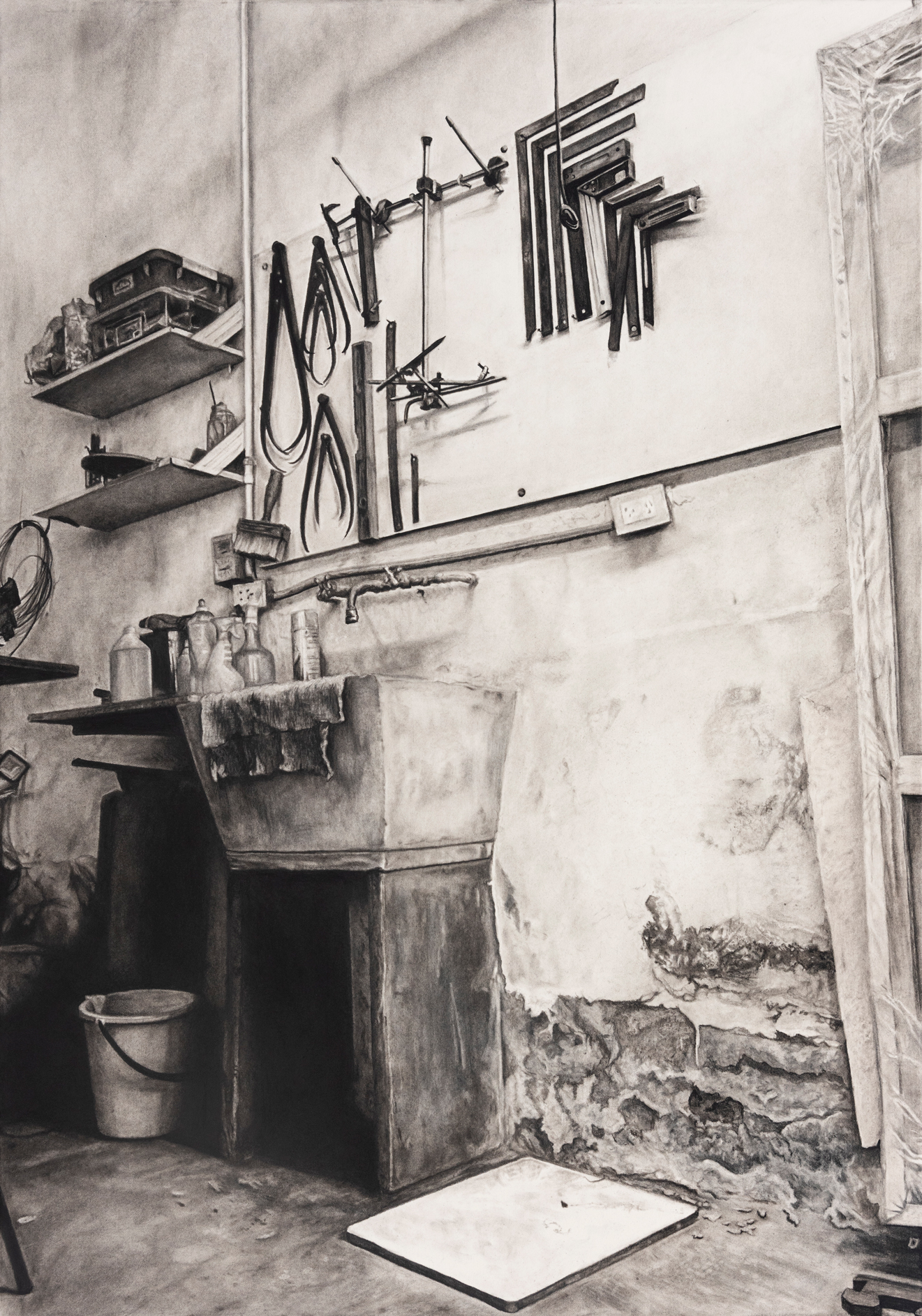
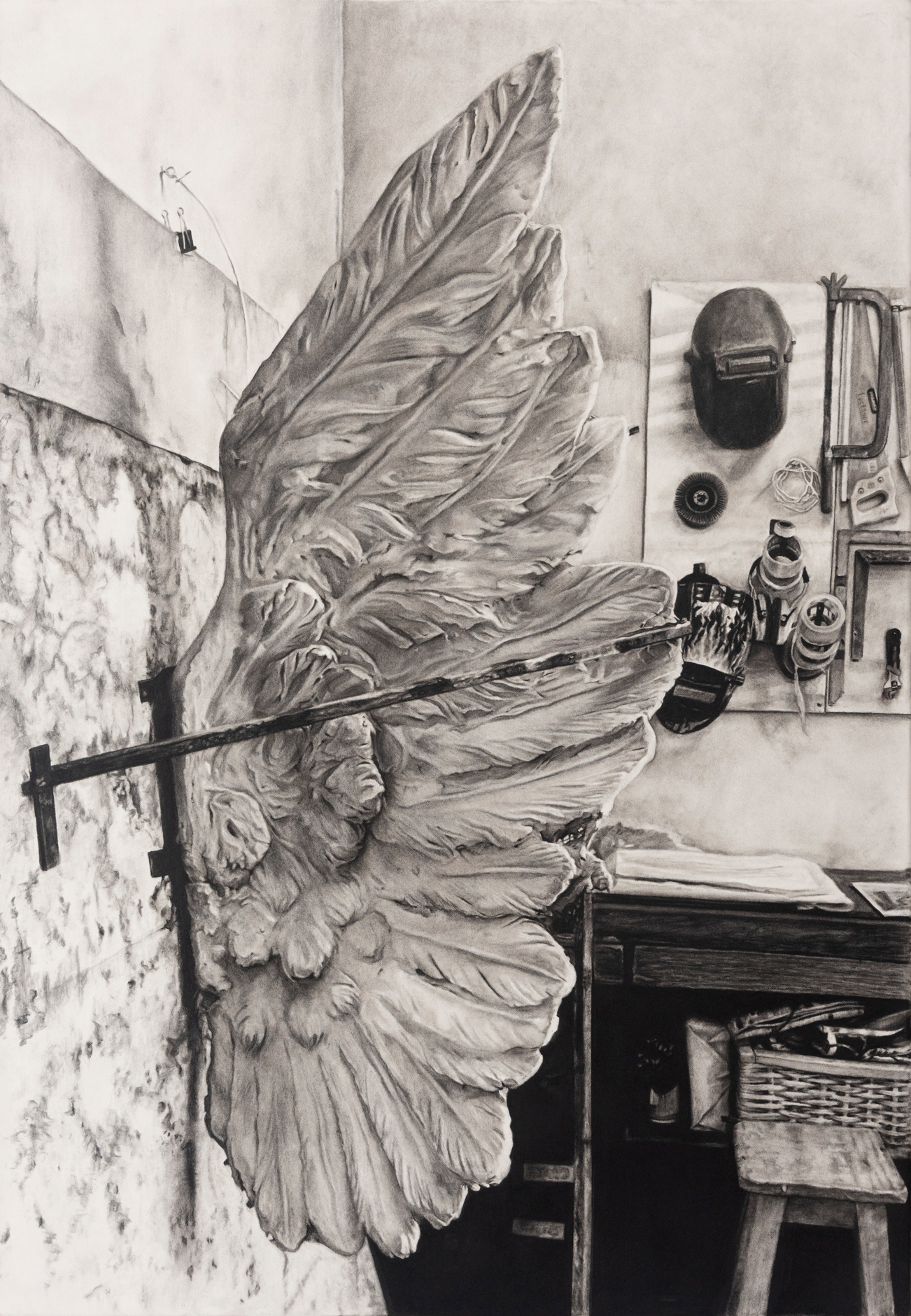
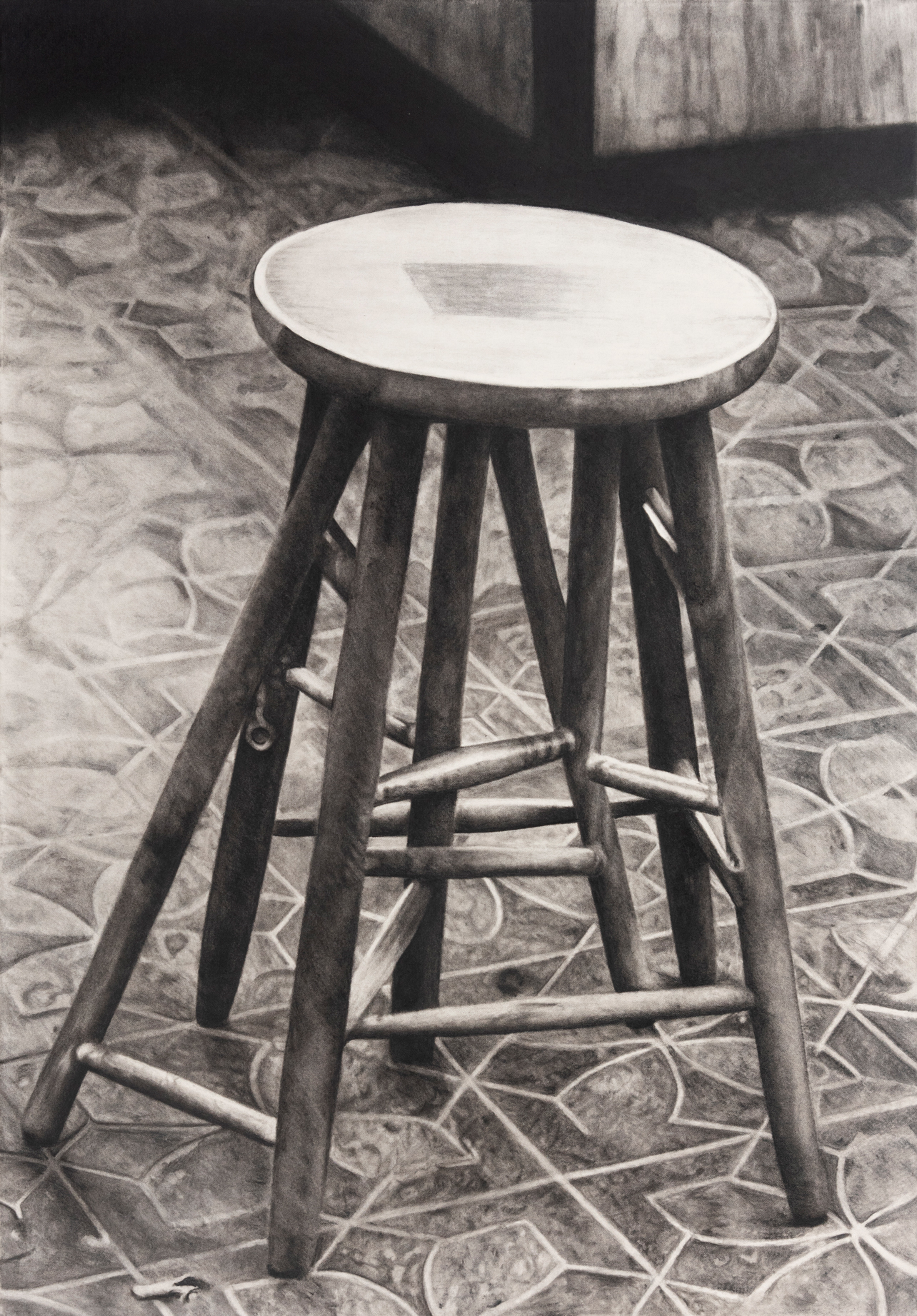
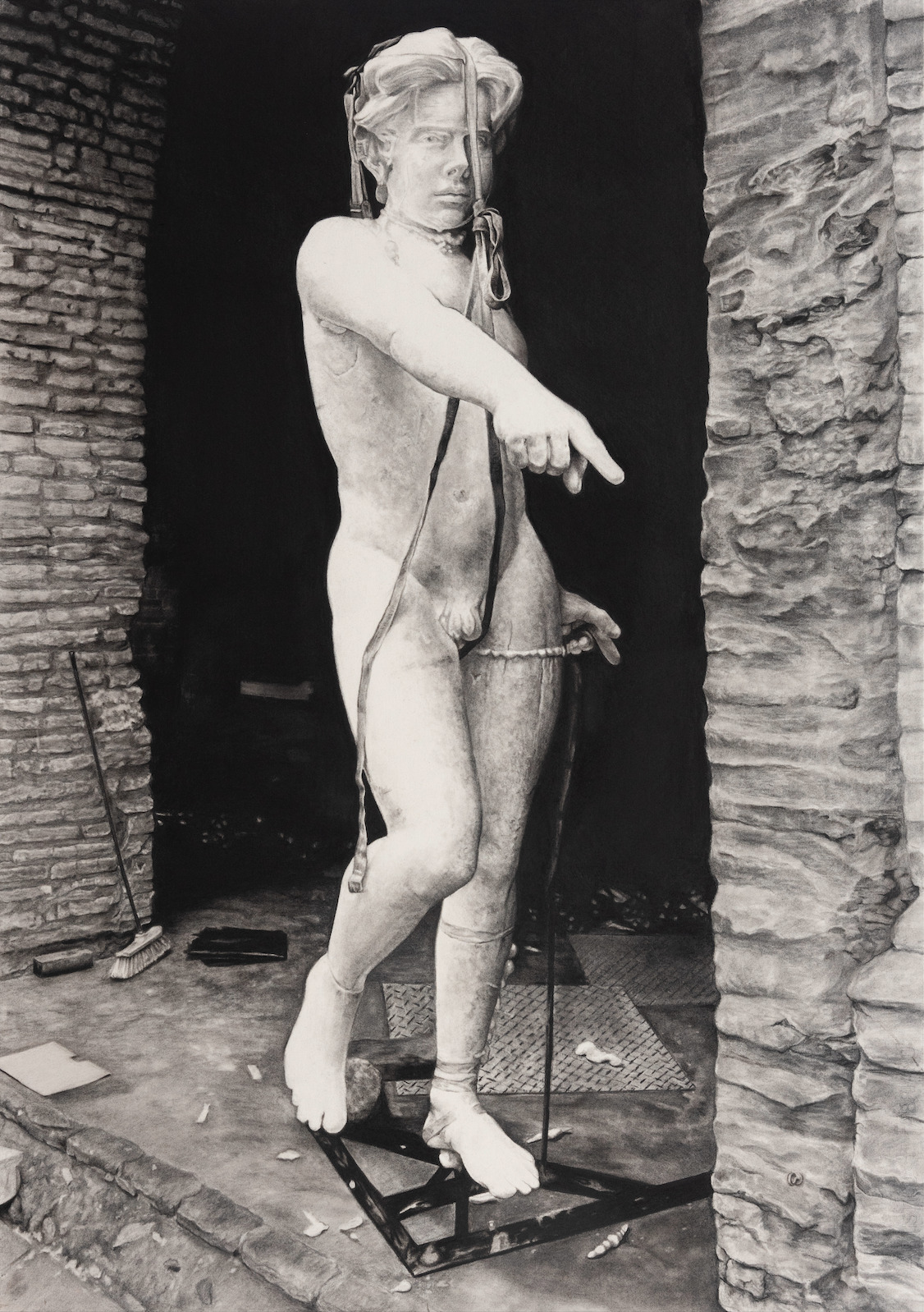
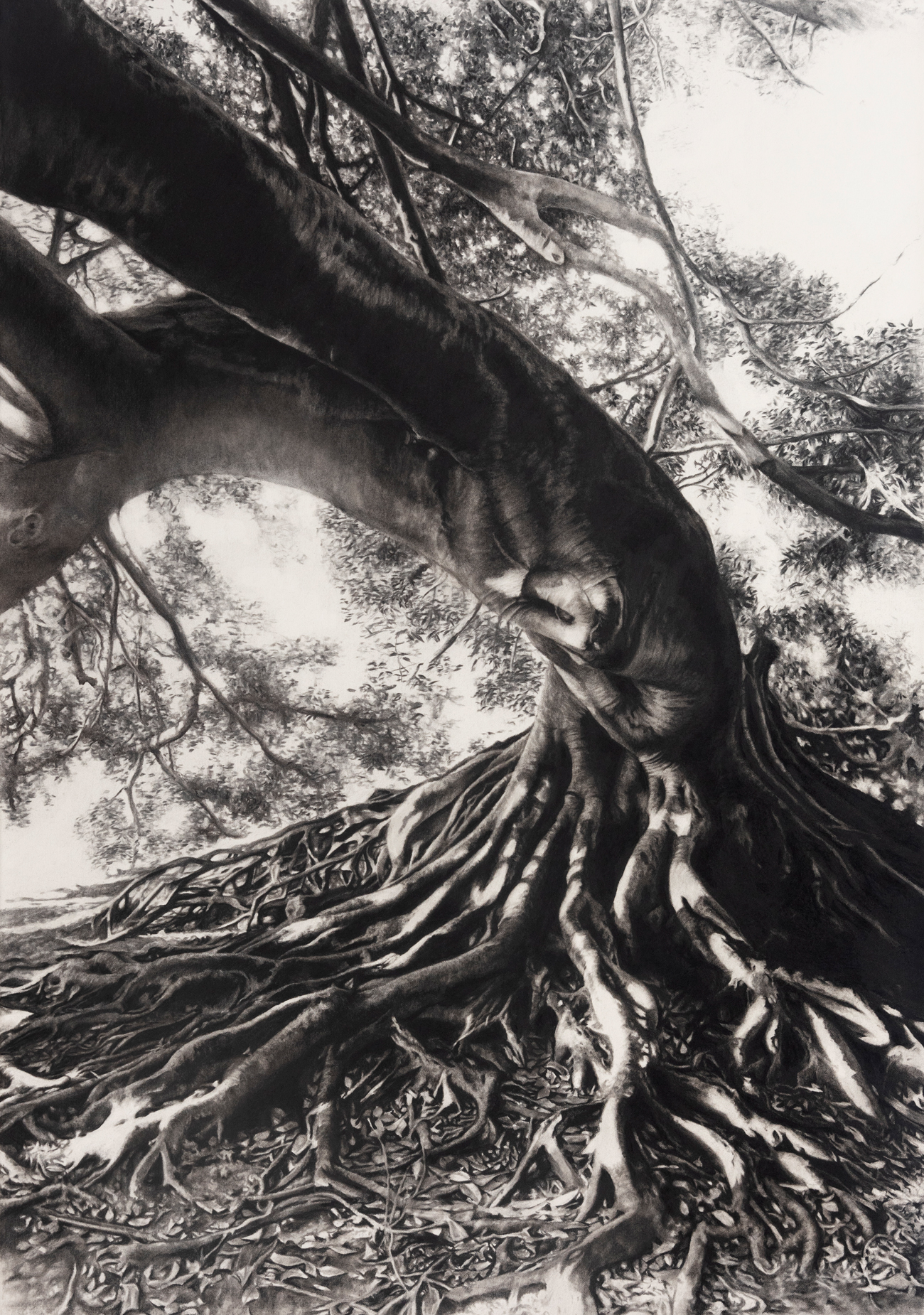
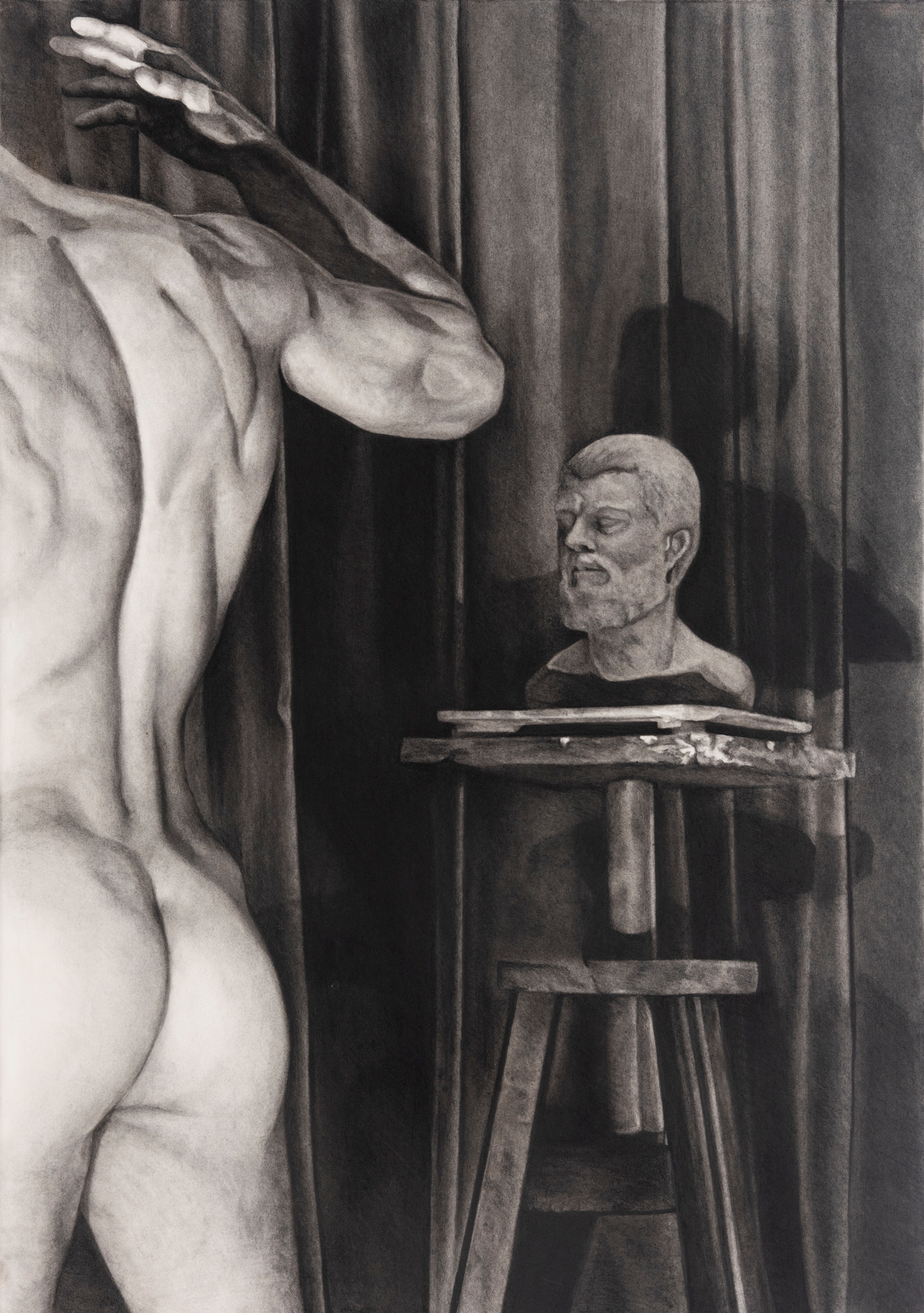
As a prelude to the mural, charcoal drawings of different scenes in Alexis's everyday life and studio work are exhibited. The neighborhood trees that populate the city of Buenos Aires are portrayed in the chaotic sensuality of their forms that press against urban boundaries and grids through their overflowing roots and branches. These views of the artist's everyday surroundings alternate with depictions of his studio that focus on the liminal space inhabited by Alexis' production as a contemporary artist who works with classical motifs and techniques. A sculpture of cherubs (putti) in a sexual game sits next to the studio window with Alexis's dumbbells and exercise bar in the background. In another scene -that cites the pictorial genre of the still life and recalls Víctor Cúnsolo’s groundbreaking painting Tradition (1931)- a workshop table displays books on modern sculpture, an anal dildo, fragments of a marble carving, and an iron model for making busts which, in this context, takes on the appearance of a sex toy. In others, working tools and fragments of sculptures in progress are seen as strange objects, signs of a productive and imaginative life that we cannot fully grasp in the image.
The voyeuristic pleasure aroused by the images in the artist's studio is evident in iconic representations throughout the history of art, such as those made by Johannes Vermeer, Gustave Courbet, or Lorenzo Vallés. The erotic tension runs through the image and is sustained by pendulum swings between the canvas within the canvas and the model, the artist's hand and the expressions of those posing. In John Koch's The Sculptor (1964) this tension between artist, body of work and human body is masterfully enshrined in a composition that amplifies the moment when the former leans over the hand of the nude model who helps him light a cigarette. Like a threatening shadow, a neoclassical bronze of enormous dynamism rises in the background, depicting a fight between two nude male figures. This sweeping force of passions in the studio stands out in Alexis's work -even in the apparent stillness of the figures in his mural -and extends to the corners of the studio in the most anodyne moments of his productive life. With this portrayal of artistic labor, Alexis reveals the coexistence of different times within the contemporary pastiche in which the romantic vision of art intersects with the current professionalization of the system. He emphasises the dream of an erotic labor that escapes the machinery of the permanent spectacle. He elaborates a space in which art imagines and produces ways of life: productive existences that are destined to enjoyment for enjoyment's sake rather than to the reproduction of capital, existences that give themselves over to expansion and self-discovery through the immediate transformation of reality.
Leandro Martínez Depietri
![Erótica laboral [Workplace Erotica] (2022). Clay, refractory powder, and oakum, 400 x 650 cm](img/exhibitions/erotica/1.jpg)
![Erótica laboral [Workplace Erotica] Exhibition view.](img/exhibitions/erotica/2.jpg)
![Erótica laboral [Workplace Erotica] Exhibition view.](img/exhibitions/erotica/3.jpg)
![Erótica laboral [Workplace Erotica] Exhibition view.](img/exhibitions/erotica/4.jpg)
![Erótica laboral [Workplace Erotica] Exhibition view.](img/exhibitions/erotica/5.jpg)
![Erótica laboral [Workplace Erotica] Exhibition view.](img/exhibitions/erotica/6.jpg)
![[untitled] (2022). Lost-wax bronze casting, 16 x 18 x 7 cm](img/exhibitions/erotica/16.jpg)
![[untitled] (2022). Lost-wax bronze casting, 16 x 7 x 7 cm](img/exhibitions/erotica/17.jpg)
![Erótica laboral [Workplace Erotica] Creation process.](img/exhibitions/erotica/18.jpg)
![Erótica laboral [Workplace Erotica] Creation process.](img/exhibitions/erotica/19.jpg)
![Erótica laboral [Workplace Erotica] Creation process.](img/exhibitions/erotica/20.jpg)
![Erótica laboral [Workplace Erotica] Creation process.](img/exhibitions/erotica/21.jpg)