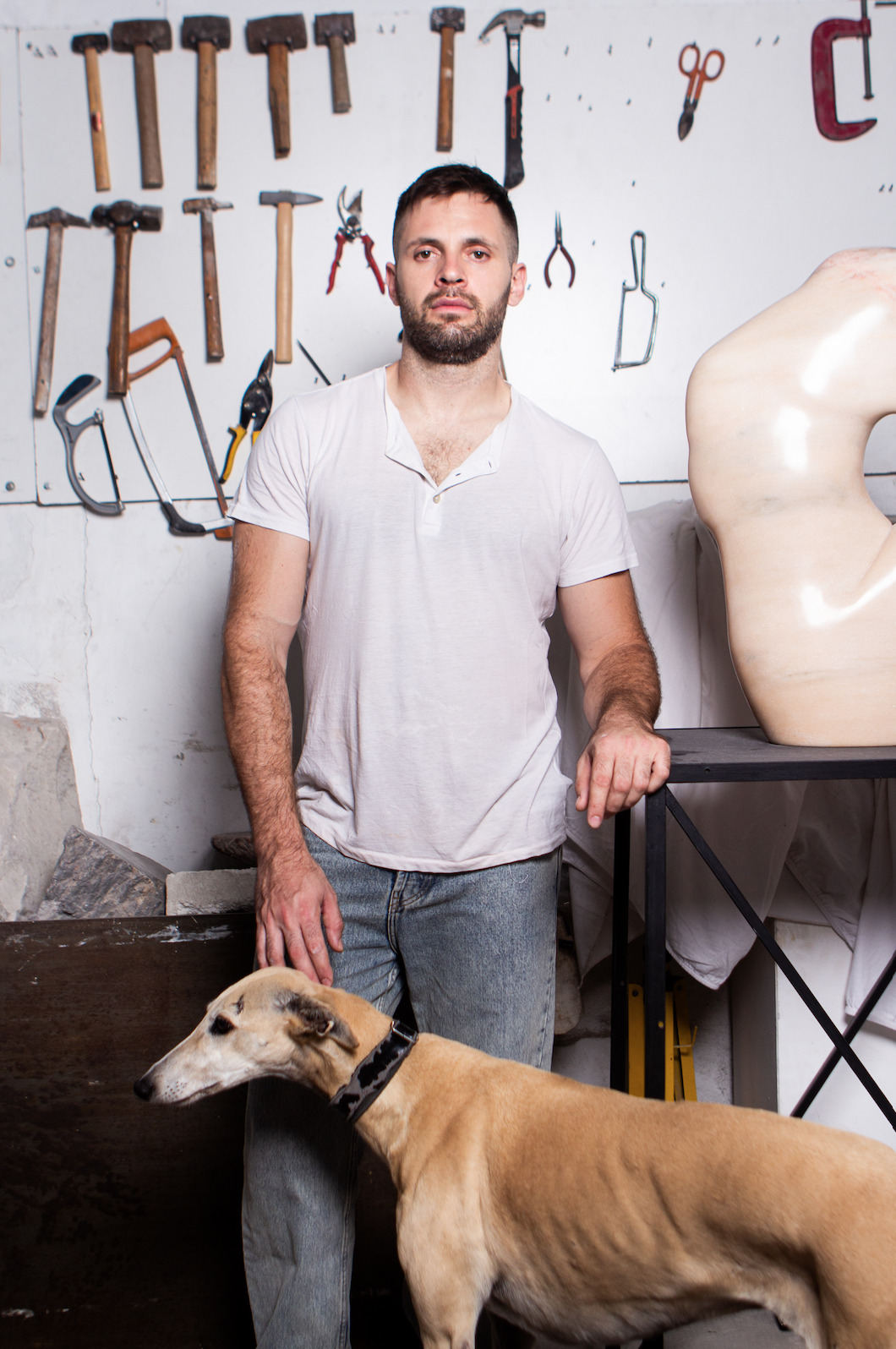
The work of Alexis Minkiewicz (Villa Cañás, 1988) unfolds as a poetic and political exploration of the signs that shape public space, urban memory, and the reconfiguration of identities. His practice—which encompasses sculpture, drawing, and installation—moves away from linear narratives to construct a sensory archive where nineteenth-century monuments, century-old trees, public and private institutions, and everyday presences that form part of his affective universe coexist.
At the heart of his work lies a critical reexamination of urban space and its symbols: from drawings of monumental gum trees that form part of the construction of the national landscape to pieces that engage with established icons of power, revealing their ideological layers, fissures, and silences. These material and symbolic drifts challenge established notions of bodies and their inscription in the city. Minkiewicz subverts the academic canon with amorphous bodies, ephemeral gestures, and anonymous journeys.
His queer gaze does not illustrate an identity, but rather challenges the visual regime that determines who can be seen and how. He is interested in the margin, the fold, the furtive encounter; that which escapes surveillance and opens up the possibility of imagining other ways of inhabiting. More than a unified body of work, his practice is a living body in constant transformation.
Bio
Alexis Minkiewicz was born on March 11, 1988, in Villa Cañás, Santa Fe Province, Argentina. He grew up in between Avellaneda and Lanús, in the Buenos Aires metropolitan area. He studied at the National University of the Arts (UNA) and in Dolores Casares’s studio. He took classes with Ernesto Ballesteros.
In 2013, he presented his first solo exhibition, The double is oneself, at Aldo de Sousa Gallery. Two years later, in 2015, he was selected to participate in the residency program at the Port Tonic Art Center in Les Issambres, France, and was awarded the Haroldo Conti Fellowship in Buenos Aires, where he took part in a workshop with Silvia Gurfein, Eduardo Basualdo, and Tulio de Sagastizábal. In 2016, his works were exhibited at Torcuato Di Tella University and the Recoleta Cultural Center. In 2017, he was invited by the University of Łódź, Poland, to exhibit his work on the Białowieża Forest; and in 2019, he was commissioned to create the inaugural exhibition at the La Boca Museum of Contemporary Art (MARCO), where he presented the exhibition Rep(úb)lica, curated by Leandro Martínez Depietri. In 2021, he won the public sculpture competition launched by the National Ministry of Culture to honor the heroine of independence, María Remedios del Valle, with the work Possible Portrait of María Remedios del Valle by Louis Yupanqui. In 2022, he presented Workplace Erotica at the inaugural exhibition of the Enlace AP art space in Serra de Daró, Baix Empordá, Autonomous Community of Catalonia, Spain, curated by Martínez Depietri. In 2024, in collaboration with curator Marina Aguerre, he opened Salto al potro at Galería de Sousa. In 2026, once again at de Sousa, he presented Darse, his most recent solo show.
During the 2024–2025 biennium, he further developed his work with marble at the Mantica residency in Carrara, Italy. In 2025, at Galería de Sousa’s booth at ArteBA, he exhibited, among other works, *Michelle*, a sculpture over two meters tall and a ton in weight, carved from white Carrara marble and dedicated to his friend Michelle Lacroix, a trans woman poet, singer, and performer from Chaco.
He participated in the Bahía Blanca Biennial in Argentina (2014); the Santa Cruz de la Sierra Biennial in Bolivia (2016); the Curitiba Biennial in Brazil (2019); and BIENALSUR (2021), the International Biennial of Contemporary Art organized by the National University of Tres de Febrero (UNTREF).
He lives and works in the neighborhood of Barracas, in Buenos Aires.