El doble es uno [The double is oneself]
November 2013
Aldo de Sousa Gallery
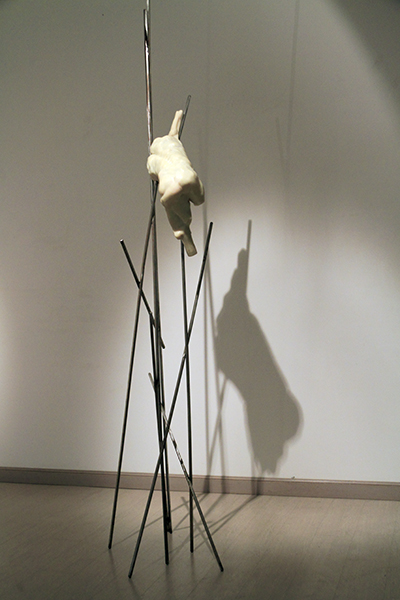
For his first solo exhibition, Minkiewicz worked with resin and iron sculptures and graphite drawings. It was an initial approach to the three-dimensional production in which the sculptural ensembles transferred to the space some of his germinal visions in drawing. Both media coexisted in this exhibition in which it is possible to perceive the influence of Francis Bacon's paintings and, at a local level, of the sculptures of Norberto Gómez and Alberto Heredia. The works show acephalous bodies in conflict, sometimes amorphous, sometimes fused together or balancing in sharp and inhospitable structures. Other bodies reunite flesh with mineralogical structures or bring animal tissues closer to rocky or even architectural morphologies, forming an extraterrestrial topography that randomly imbricates the organic with the inorganic. The exhibition, without a defined narrative, showcases Minkiewicz’s different aesthetic languages and possibilities. What the works share in common is a brutal, forced, and sombre character.
In his reference to the figure of the double, Minkiewicz revisits an atavistic motif in Western literature and the arts that gained particular prominence during the Romantic period. Central to psychoanalysis as well, the concept of the double is addressed by Freud in relation to the notion of the unheimlich (the uncanny) and to the mirror image as a reminder of death. For Lacan, the imago of the double is a process of mental identification in which the object of the ego’s desire is revealed through jealousy, transforming human knowledge into a paranoid structure. In any case, narcissistic splitting is associated with processes of maturation and self-knowledge linked to fear, erotic drives, and death drives. In this sense, Minkiewicz undertakes a sort of initiatory journey of youth through this exhibition, in which he delves into and explores both his expressive possibilities as an artist and his own fears, obsessions, fantasies, and whims.
Leandro Martínez Depietri
![El doble es uno. [The double is oneself] Exhibition view](img/exhibitions/doble/1.jpg)
![El doble es uno [The double is oneself]. Exhibition view](img/exhibitions/doble/2.jpg)
![El doble es uno [The double is oneself]. Exhibition view](img/exhibitions/doble/3.jpg)
![El doble es uno [The double is oneself]. Exhibition view](img/exhibitions/doble/4.jpg)
![El doble es uno [The double is oneself]. Exhibition view](img/exhibitions/doble/5.jpg)
![El doble es uno [The double is oneself]. Exhibition view](img/exhibitions/doble/6.jpg)
![El doble es uno [The double is oneself]. Exhibition view](img/exhibitions/doble/7.jpg)


![El doble es uno [The double is oneself]. Exhibition view](img/exhibitions/doble/11.jpg)
![El doble es uno [The double is oneself]. Exhibition view](img/exhibitions/doble/12.jpg)
![El doble es uno [The double is oneself]. Exhibition view](img/exhibitions/doble/13.jpg)
![El doble es uno [The double is oneself]. Exhibition view](img/exhibitions/doble/14.jpg)
![[untitled] (2013). Graphite and charcoal on paper](img/exhibitions/doble/15.jpg)
![[untitled] (2013). Graphite and charcoal on paper](img/exhibitions/doble/16.jpg)
![[untitled] (2013). Graphite and charcoal on paper](img/exhibitions/doble/17.jpg)
![[untitled] (2013). Graphite and charcoal on paper](img/exhibitions/doble/18.jpg)
![[untitled] (2013). Graphite and charcoal on paper](img/exhibitions/doble/19.jpg)